You don't need a gym, a yoga mat, or a 30-minute workout to give your spine a meaningful reset during the workday. A simple 5-minute routine — done at your desk, in your work clothes — can help interrupt the cycle of sustained sitting, release accumulated tension, and reset your posture for the next block of work.
This routine is designed for desk workers in Metro Manila — professionals in Ortigas, Makati, BGC, and Mandaluyong who spend most of their day at a screen and need practical, realistic wellness habits that fit into a real workday.

When to Do This Routine
The ideal time to do this routine is after every 45–60 minutes of sustained sitting. If that's not practical, aim for at least twice during your workday — once in the mid-morning and once in the mid-afternoon, when the effects of prolonged sitting tend to be most noticeable.
The 5-Minute Spine Reset
Step 1: Stand Up and Breathe (1 minute)
Simply stand up from your chair. Place your feet hip-width apart and let your arms hang naturally at your sides. Take five slow, deep breaths — breathing in through your nose for a count of four, and out through your mouth for a count of six. As you breathe, consciously relax your shoulders, unclench your jaw, and let your hands soften.
This first step is more important than it might seem. Standing up interrupts the sustained compressive load on your spinal discs, and the deep breathing begins to activate your parasympathetic nervous system — shifting your body from stress mode toward recovery mode.
Step 2: Shoulder Rolls and Neck Release (1 minute)
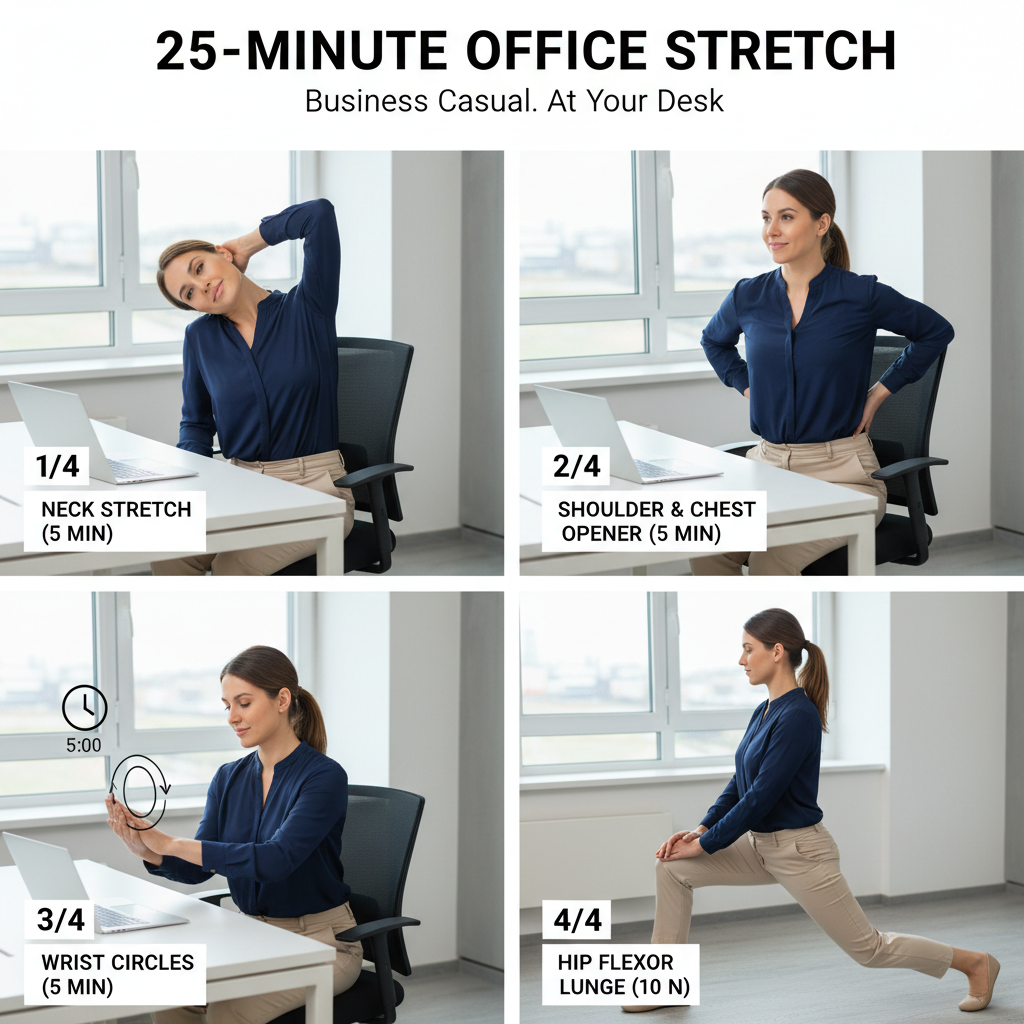
Roll your shoulders slowly backward five times, making large, deliberate circles. Then gently tilt your head to the right, bringing your right ear toward your right shoulder — hold for 15 seconds. Repeat on the left side. Finally, slowly drop your chin toward your chest and hold for 15 seconds.
These movements target the trapezius and neck muscles — the areas where tension most commonly accumulates during desk work.
Step 3: Chest Opener (1 minute)
Interlace your fingers behind your back. Gently squeeze your shoulder blades together and lift your chest, opening the front of your body. Hold for 20 seconds, breathing deeply. Release, shake out your arms, and repeat twice.
This movement counteracts the forward-rounded posture that develops from hours of keyboard work, helping to restore the natural alignment of your upper spine.
Step 4: Standing Hip Flexor Stretch (1 minute)
Step your right foot forward into a gentle lunge position, keeping your back straight. Gently push your hips forward until you feel a stretch in the front of your left hip. Hold for 20 seconds, then switch sides.
The hip flexors shorten significantly during prolonged sitting and are a primary contributor to lower back tension. This stretch is one of the most effective things you can do for your lower back during the workday.

Step 5: Gentle Spinal Rotation (1 minute)
Sit back in your chair with your feet flat on the floor. Place your right hand on the outside of your left knee and gently rotate your upper body to the left, looking over your left shoulder. Hold for 15 seconds, breathing deeply. Return to center and repeat on the other side.
Spinal rotation helps restore mobility to the thoracic spine — the upper and mid-back — which tends to become stiff and immobile from sustained sitting.
- Set a recurring alarm on your phone labeled "Spine Reset" — the reminder is the hardest part.
- Do the routine in the same place each time — standing next to your desk — to build a location-based habit cue.
- If you can't do all 5 steps, even steps 1 and 2 alone will make a difference.
- Invite a colleague to join you — habits are easier to maintain with social support.
Five minutes. Done consistently. That's the entire commitment. The cumulative effect of this small daily practice — on your posture, your energy levels, and how your body feels at the end of the day — can be genuinely meaningful over weeks and months.