
If you spend most of your working hours at a desk, your spine is under a kind of quiet, sustained stress that most people never think about. It's not dramatic — there's no single moment of injury or strain. It's the accumulation of thousands of hours in a seated position, with a screen in front of you and a keyboard under your hands.
The good news is that you don't need to overhaul your entire lifestyle to make a meaningful difference. A few consistent habits — applied every day — can significantly change how your spine and body feel over time.
Habit 1: Set Up Your Workstation Properly
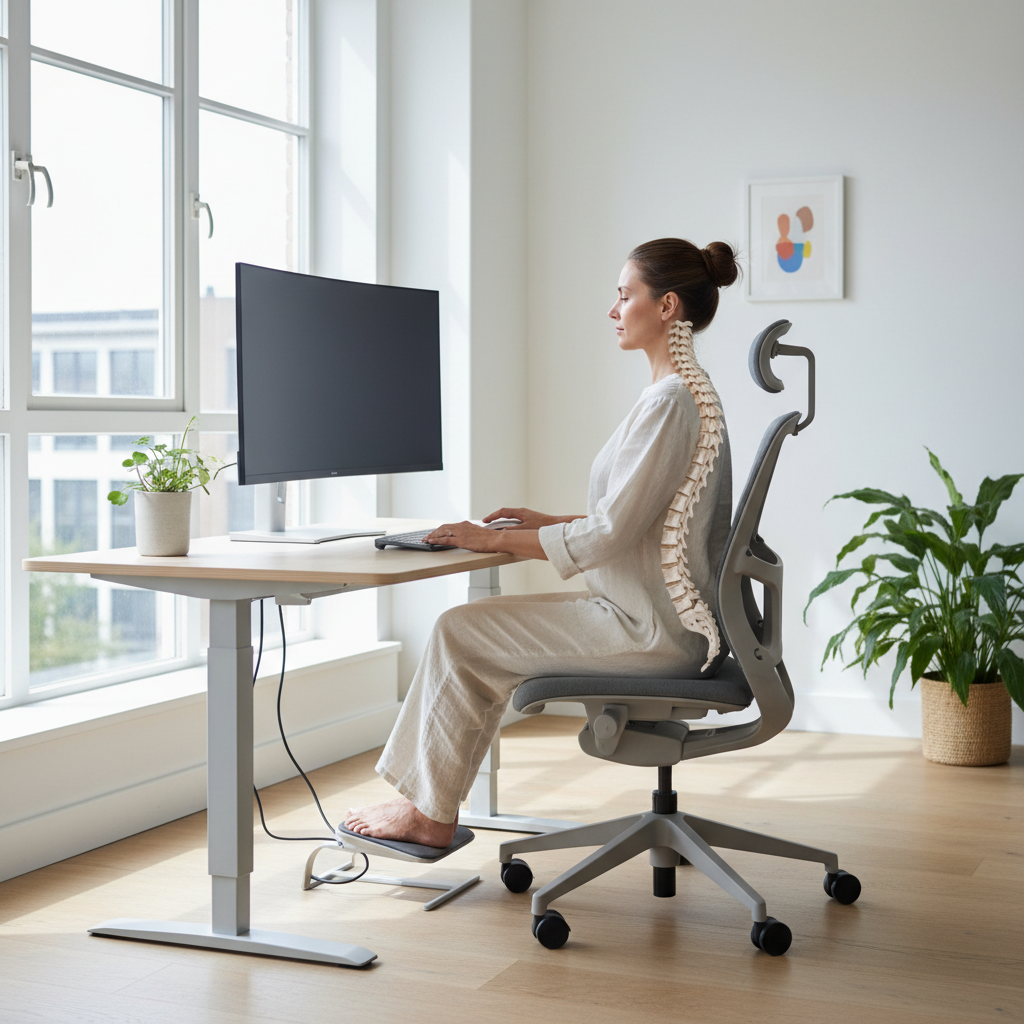
Your workstation setup is the foundation of your spine habits. Even the best intentions about posture will be undermined if your chair, screen, and keyboard are in the wrong position.
- Screen at eye level: the top of your monitor should be roughly at eye height, so you're looking slightly downward at the center of the screen.
- Chair height: your feet should be flat on the floor (or on a footrest), with your knees at approximately a 90-degree angle.
- Lower back support: your chair should support the natural inward curve of your lower back. If it doesn't, a small rolled towel or lumbar cushion can help.
- Keyboard and mouse: positioned so your elbows are at roughly 90 degrees and your wrists are neutral — not bent up or down.
- Distance from screen: roughly an arm's length away.
Habit 2: Move Every Hour
This is the single most impactful habit you can build. The human body is not designed for sustained static posture — it's designed for movement. Even brief interruptions to prolonged sitting can make a meaningful difference in how your spine and muscles feel.
You don't need to go to the gym or do a full workout. Simply standing up, walking to the water cooler, or doing a few gentle stretches for 2–3 minutes every hour is enough to interrupt the cycle of sustained muscle loading and reduced circulation.

The 20-20-20 Principle
A useful framework for desk workers: every 20 minutes, look at something 20 feet away for 20 seconds. This is primarily recommended for eye health, but it also serves as a natural reminder to shift your posture and take a brief mental break.
Habit 3: Be Intentional About How You Sit
Most people don't think about how they're sitting — they just sit. But developing a brief moment of awareness each time you sit down can gradually improve your default posture.
When you sit down, take a moment to: sit back in your chair so your lower back is supported, place your feet flat on the floor, relax your shoulders down and back (not hunched up toward your ears), and position your screen at eye level before you start working.
Habit 4: Build a Recovery Routine
What you do after work matters as much as what you do during work. After a long day of sitting, your body needs time to decompress and recover. A short evening routine — even 10–15 minutes — can help your spine and muscles reset.
- A short walk after dinner to get your circulation moving and your spine into a more natural upright position.
- Gentle stretching focused on the hip flexors, chest, and upper back — areas that tend to tighten from prolonged sitting.
- A warm shower or bath, which can help relax the muscles along your spine and shoulders.
- Mindful relaxation — even 10 minutes of quiet rest can help your nervous system transition from the demands of the workday.
Habit 5: Pay Attention to Your Body's Signals
Your body communicates with you constantly. The stiffness you feel when you stand up after a long meeting, the tension in your neck by mid-afternoon, the ache in your lower back at the end of the day — these are signals worth paying attention to.
Rather than pushing through discomfort or waiting until it becomes a problem, treat these signals as prompts to move, adjust your position, or take a break. Building this kind of body awareness is one of the most valuable wellness habits you can develop.
What You Can Do Today
- Spend 5 minutes today adjusting your workstation setup using the checklist above.
- Set a recurring timer on your phone for every 50 minutes — when it goes off, stand up and move for 2 minutes.
- Tonight, spend 10 minutes on gentle movement or stretching before bed.
- Tomorrow morning, notice how you sit down at your desk — and take one moment to set up your posture before you start working.
Building better spine habits doesn't require a dramatic lifestyle change. It requires consistent, small actions — repeated every day. Over weeks and months, these small actions compound into a meaningful difference in how your body feels.